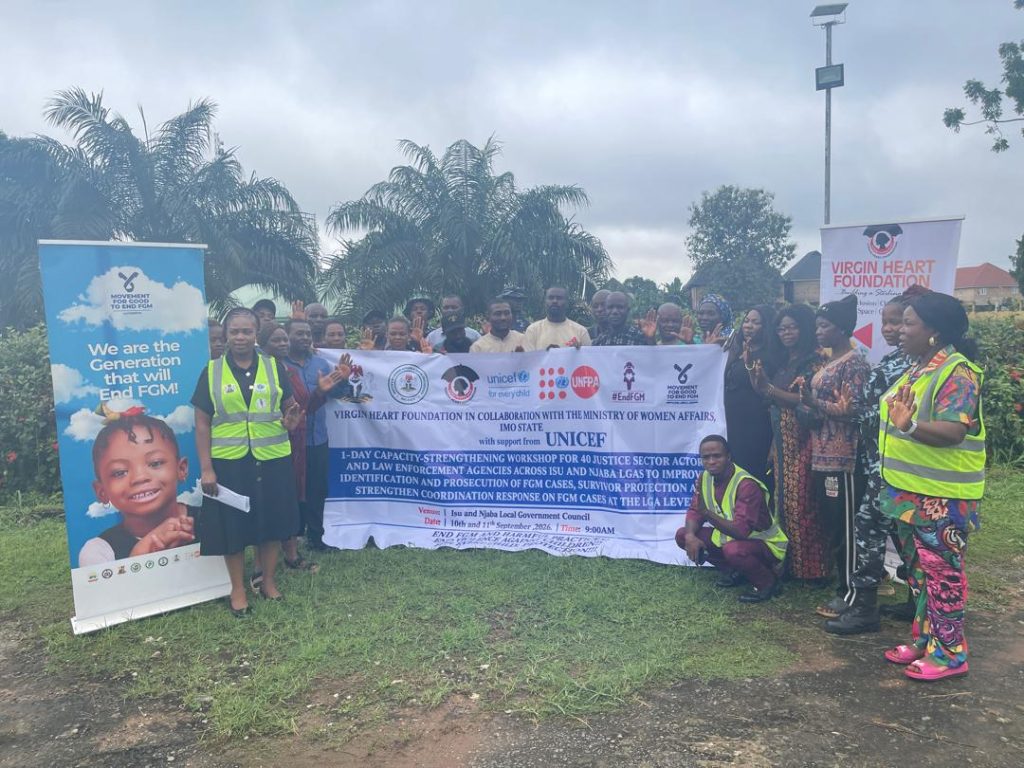
Imo Yet to Prosecute FGM Case, Justice Ministry Raises Concern Over Reporting Gap.
The Imo State Ministry of Justice has expressed concern that no case of Female Genital Mutilation (FGM) has so far been prosecuted in the state, despite existing laws prohibiting the harmful practice.
The Ministry therefore called for improved identification, reporting, investigation, documentation, and prosecution of FGM cases, particularly at the grassroots level.
The Desk Officer for Sexual and Gender-Based Violence against Women and Principal State Counsel at the Imo State Ministry of Justice, Chika Ndubuisi, Esq., disclosed that despite spending 21 years in the legal profession, she had never witnessed a case involving an FGM perpetrator being prosecuted in court.
She made the disclosure during a One-Day Capacity Strengthening Workshop for Justice Sector Actors and Law Enforcement Agencies in Isu and Njaba Local Government Areas, organized by Virgin Heart Foundation (VHF) in collaboration with the Imo State Ministry of Women Affairs, with support from UNICEF.
The workshop, held at the respective Local Government Secretariats, brought together justice sector actors and community stakeholders, including personnel of the Nigeria Police Force, the judiciary, community-based organizations, FGM survivors, the Nigeria Security and Civil Defence Corps, local vigilante groups, civil society and representatives of the local government authorities.
The workshop provided a platform for participants to discuss the identification, reporting, investigation, prosecution, and management of FGM cases at the grassroots level, with particular emphasis on strengthening coordination among justice and protection actors.
The Ministry of Justice highlighted the apparent gap between existing legal provisions and their practical enforcement. The Ministry attributed part of the challenge to the culture of silence surrounding FGM in many communities, where residents may be reluctant to report cases when they occur.
Ndubuisi urged community members and stakeholders to identify and report suspected FGM cases through appropriate community structures, vigilante groups, security agencies, and the police, after which cases can be referred to the Ministry of Justice for appropriate legal action.
Speaking on behalf of the UNICEF Chief Field Officer, Juliet Chiluwe, the Child Protection Specialist from the UNICEF Enugu Field Office, Victor Atuchukwu, stressed the importance of successful prosecution in creating a deterrent effect.
He noted that successfully prosecuting even one FGM case could send a strong message to others within the community and emphasized the need for suspected cases to be reported with adequate evidence to support investigation and prosecution.
He highlighted that security agents and all actors must be willing to withdraw from all Cultural biases for full implementations of FGM to be fully realized in the state.
The Executive Director of Virgin Heart Foundation, Peace Dike, said ending FGM requires strong inter-agency collaboration among justice sector institutions and other stakeholders, including the Ministries of Women Affairs, Health, Information, Commerce and Trade, religious organizations, traditional and community leaders, security agencies, and vigilante groups.
She explained that these actors are strategically trained and positioned within communities to identify, document, report, refer, and support the effective management of FGM cases.
Dike reiterated that the objective of the justice-sector capacity-building workshop was to ensure that justice actors understand how to identify, document, manage, and prosecute evidence-based FGM cases within communities.
She emphasized that effective case management is critical to ensuring that FGM cases do not end at the point of reporting but proceed through the appropriate justice, protection, health, and referral mechanisms.
As part of the workshop, Dike shared documented FGM cases with participants, providing practical examples to facilitate discussions on evidence gathering, case handling, survivor protection, referral pathways, and prosecution.
A representative of the Imo State Ministry of Women Affairs also argued that the law itself is not necessarily weak, identifying the failure to report cases as one of the major factors undermining the effectiveness of existing legal protections against FGM.
Participants were reminded of relevant provisions under the Violence against Persons (Prohibition) Law (VAPP), the Child Rights Law, and the Prohibition of Female Genital Mutilation Law, including the possibility of imprisonment for persons found guilty of relevant offences.
The workshop concluded with renewed calls for stronger community-level reporting mechanisms, improved inter-agency collaboration, survivor-centred case management, and increased commitment by justice and law enforcement actors to ensure that FGM cases are properly investigated and prosecuted.
Stakeholders stressed that ending FGM requires not only the existence of laws but also effective enforcement, community reporting, adequate evidence gathering, survivor protection, and coordinated action across the justice and protection sectors.